laravel-ecr17
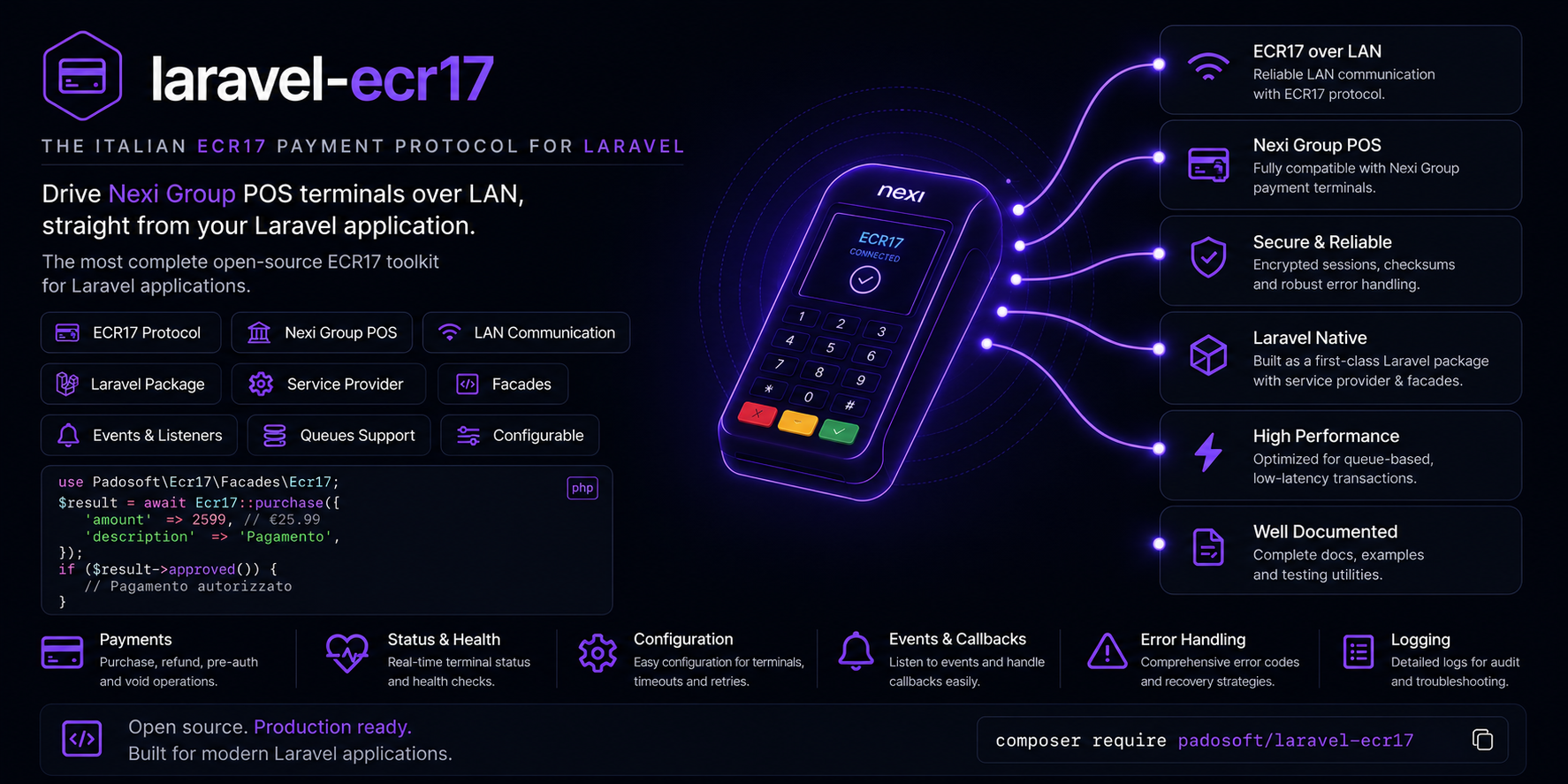



laravel-ecr17 speaks the Italian ECR17 / “Protocollo 17” amount-exchange protocol to Nexi Group POS terminals over TCP — straight from your Laravel app.
A framework-free protocol core (framing, LRC, the ACK/NAK handshake with retransmission and timeouts, every command builder and every response parser) wrapped in a thin Laravel layer — with a money-safety invariant that guarantees a dropped connection can never double-charge a card.
In five minutes you’ll know exactly what this package is, the problem it solves, why it beats hand-rolling a socket client, and where to click next. Every other page goes deeper — this one gives you the whole picture.
What it is — in one minute
To take a card payment from a cash register (ECR) you have to talk to the payment terminal (POS) in its own language. In Italy that language is ECR17 / “Protocollo 17”, the amount-exchange protocol spoken over TCP/IP by Nexi Group terminals. The ECR frames an application message (STX … ETX LRC), the terminal ACK/NAKs it, streams progress and receipt lines, and finally returns the transaction result.
Getting that right by hand is deceptively hard: byte framing, the LRC checksum, ACK/NAK retransmission with timeouts, half-open sockets between transactions, and — most dangerously — what to do when the line drops after the card was charged but before the result arrived.
laravel-ecr17 implements the full protocol for you:
- Every ECR17 command — status, pay, extended pay, reverse, pre-auth, incremental auth, pre-auth closure, card verification, close session, totals, send-last-result, ECR printing, reprint, VAS, plus tokenization (
U). - A money-safe session — a financial command is never blindly re-sent after a drop; recover a lost result with
sendLastResult()(G). Proactive reconnection keeps a payment from ever starting on a dead socket. - Real-time streaming — progress messages and receipt lines surface through events/callbacks as the cardholder interacts with the terminal.
In one line: the complete, money-safe ECR17 protocol stack for PHP & Laravel — pure-PHP core, thin Laravel wrapper, tested 1:1 against its React Native sibling.
The problem it solves
Every team integrating a Nexi POS over Protocollo 17 hits the same wall. Here is the gap this package closes.
| Without laravel-ecr17 | With laravel-ecr17 |
|---|---|
You hand-build STX … ETX LRC framing and the LRC checksum — and get an off-by-one wrong in production. |
A unit-tested codec frames and validates every packet, with selectable LRC modes (stx | std | noext | stx_noext). |
You bolt retransmission onto raw fsockopen and hope the timeouts are right. |
The ACK/NAK handshake, retransmission count and per-phase timeouts are built in and configurable. |
| A dropped line after the charge makes you guess: re-send and risk a double charge, or skip and lose the result. | A locked invariant: financial commands are never replayed; recover the real outcome with sendLastResult() (G). |
| Nexi terminals silently close the socket between transactions; your next payment fails on a half-open connection. | A non-destructive liveness probe reconnects before sending, so a payment never starts on a stale socket. |
| Progress (“INSERIRE CARTA”) and receipt lines are buried in the byte stream. | Wire onProgress / onReceiptLine / onConnectionStateChange callbacks for real-time UX. |
| Your protocol logic is tangled into Laravel and impossible to unit-test in isolation. | A framework-free core (Padosoft\Ecr17\Protocol|Response|Session) tested standalone; Laravel is a thin wrapper. |
| No reference behavior to test against — you find out it’s wrong at the till. | Tested against scripted scenarios (Pest), ported 1:1 from the React Native sibling’s GoogleTest suite. |
Who it’s for
Taking card payments through a Nexi POS at the counter? Call Ecr17::pay() and let the package own framing, handshakes, reconnection and money-safety.
Building till software or a payment bridge? A clean command/response API covers the whole ECR17 command set — payments, pre-auth, totals, VAS, tokenization.
Where a double-charge is unacceptable, the no-blind-replay invariant and sendLastResult() recovery are locked by tests, not left to your try/catch.
Shipping the same protocol on mobile? The sibling react-native-ecr17-protocol is the behavioral source of truth — identical byte layouts and test scenarios.
Why it’s different — the moats
These are the things you won’t get from a quick fsockopen wrapper or a closed vendor SDK.
A financial command is never blindly re-sent after a drop — only read-only/idempotent commands are. The rule lives in Session\RetryPolicy and is locked by its tests, so a refactor can’t silently re-enable a double-charge.
ECR17/Nexi terminals close the TCP socket between transactions. A non-destructive liveness probe runs before every command and reconnects proactively — a payment never begins on a stale, half-open socket.
Padosoft\Ecr17\Protocol\|Response\|Session is pure PHP, unit-tested in isolation. Laravel is a thin convenience layer — you can drive the client with your own transport, no framework required.
Status, pay, extended pay, reverse, pre-auth, incremental, pre-auth closure, verify card, close session, totals, send-last-result, ECR printing, reprint, VAS — and optional tokenization (U) on payments, pre-auth and verify.
Lost the result to a network blip after the card was charged? sendLastResult() (G) re-fetches the terminal’s last outcome — no re-prompt, no re-charge, no guesswork.
The protocol and test suite are ported 1:1 from the React Native / Nitro sibling, the behavioral source of truth — so PHP and mobile agree on every byte layout, offset and money-safety rule.
Host, port, terminal & ECR ids, LRC mode, auto-reconnect, connection/response/ACK timeouts, retry count/delay and receipt-drain window — all overridable via config/ecr17.php or .env.
onProgress, onReceiptLine and onConnectionStateChange callbacks stream the live cardholder journey and receipt text so your UI never shows a frozen “please wait”.
See it: the demo debug console
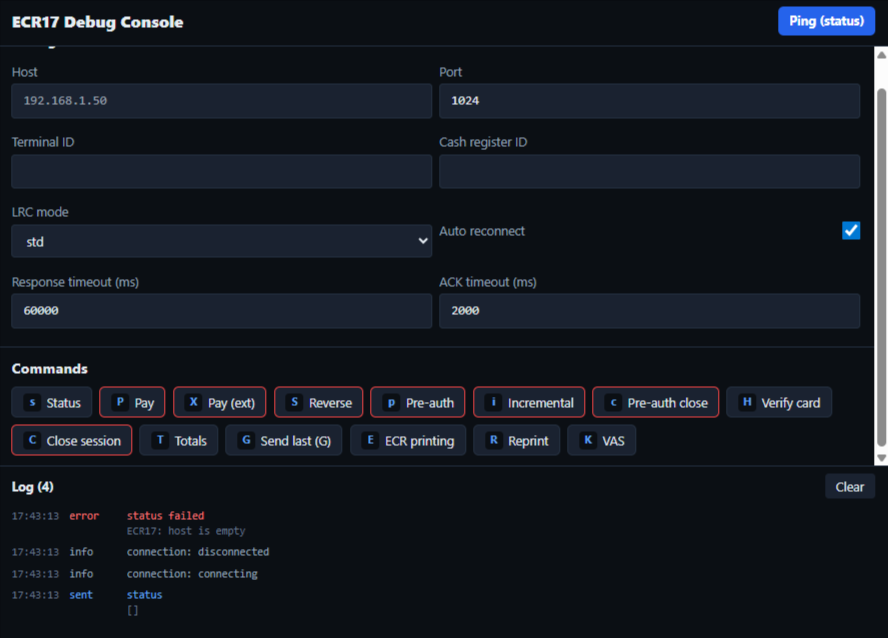
The demo/ directory ships a small Laravel app with a React + Tailwind debug console: configure and connect to a POS, run every command, and watch the behind-the-scenes log on screen and in a file. No npm/Vite build needed — it loads React + Tailwind from a CDN.
laravel-ecr17 vs. the alternatives
| Capability | laravel-ecr17 | Hand-rolled socket client | Closed vendor SDK |
|---|---|---|---|
| Full ECR17 command set (pay, pre-auth, VAS, tokenization…) | ✅ | ➖ | ✅ |
| LRC modes + ACK/NAK retransmission & timeouts built in | ✅ | ❌ | ✅ |
| Money-safe: no blind replay of financial commands | ✅ | ❌ | ➖ |
| Proactive reconnect before each command | ✅ | ❌ | ➖ |
Lost-result recovery via sendLastResult() (G) |
✅ | ❌ | ➖ |
| Framework-free, unit-testable core | ✅ | ➖ | ❌ |
| Open source, self-owned, MIT | ✅ | ✅ | ❌ |
| Behavior pinned to a cross-platform test suite | ✅ | ❌ | ➖ |
Legend: ✅ built-in · ➖ partial / DIY / not exposed · ❌ not available.
How it fits together
A command flows from your Laravel app through the facade to the client, which runs the money-safe session over a socket transport to the terminal — and streams progress and receipt lines back as it goes.
The money-safety decision in one rule:
Start in 30 seconds
Install the package
composer require padosoft/laravel-ecr17
php artisan vendor:publish --tag=ecr17-config
Configure the terminal (via
config/ecr17.phpor.env)ECR17_HOST=192.168.1.50 ECR17_PORT=10000 ECR17_TERMINAL_ID=12345678 ECR17_CASH_REGISTER_ID=1Take a payment
use Padosoft\Ecr17\Facades\Ecr17;
use Padosoft\Ecr17\Response\Outcome;

Ecr17::connect();
$result = Ecr17::pay(amountCents: 1000, paymentType: 'credit'); // €10.00

if ($result->outcome === Outcome::Ok) {
    // $result->authCode, $result->pan, $result->stan, ...
}
A payment can block while the cardholder interacts. In production, drive it from a queued job or under Octane/Swoole — never block a web request on a live payment.
→ Quickstart · → Installation · → Payments guide
Batteries included for AI-assisted development
This repo ships AI batteries — a CLAUDE.md working guide, an AGENTS.md workflow contract and invocable .claude/skills/ encoding the protocol facts, the money-safety invariant and the docs-sync discipline. Open the package in Claude Code, Cursor, Copilot or Codex and your agent already knows the house rules.
Where to go next
Why a financial command is never replayed, and how sendLastResult() recovers a lost outcome. Read →
The framework-free core, the session pipeline and the ADRs behind the design. Explore →
Every command builder, the configuration surface and the response object. Browse →
Composer padosoft/laravel-ecr17 · PHP ^8.3 (8.3–8.5) · Laravel 13 · MIT ·
GitHub · Packagist ·
Mobile sibling: react-native-ecr17-protocol
